Get in touch with UDTECH Company

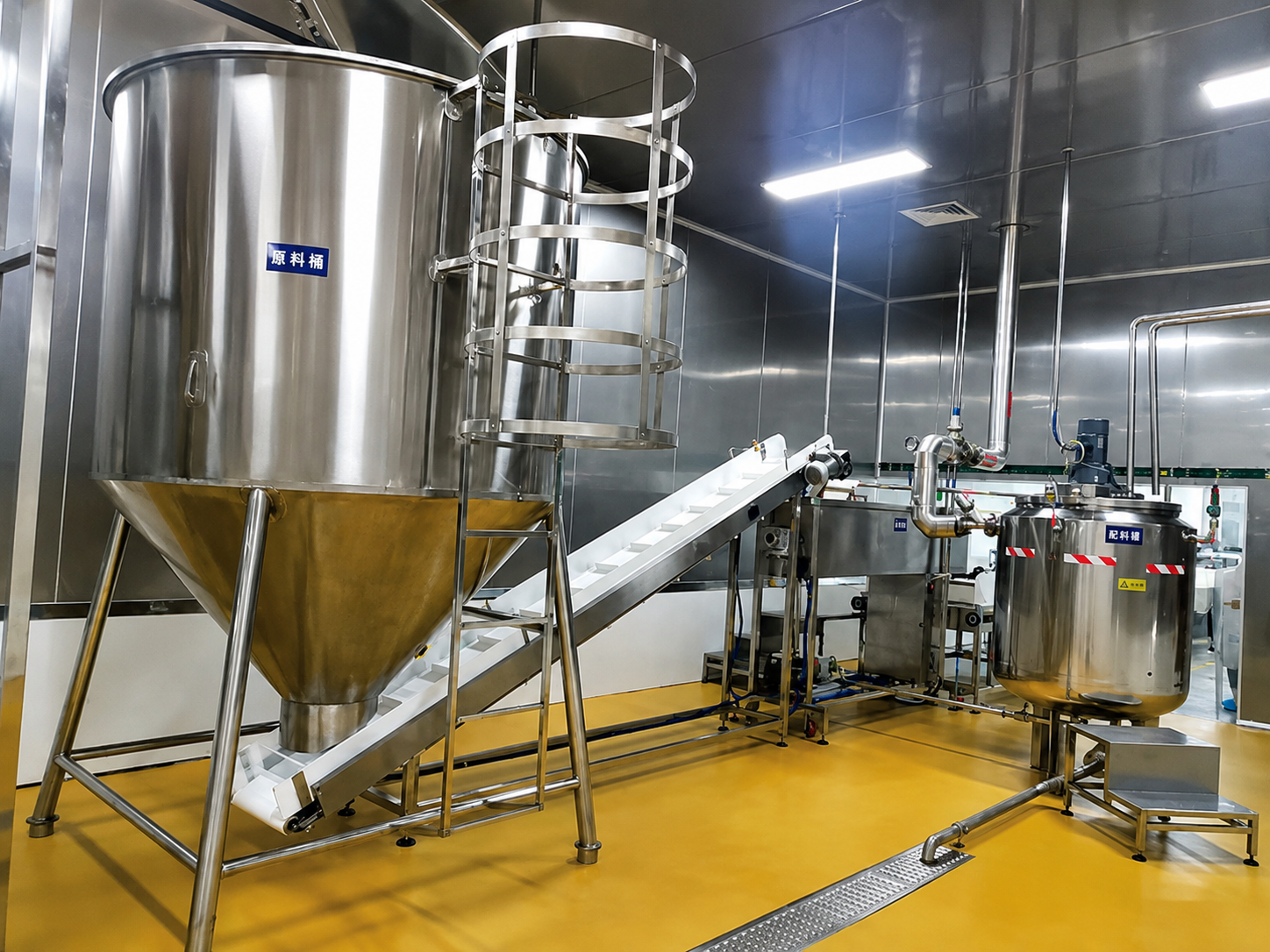
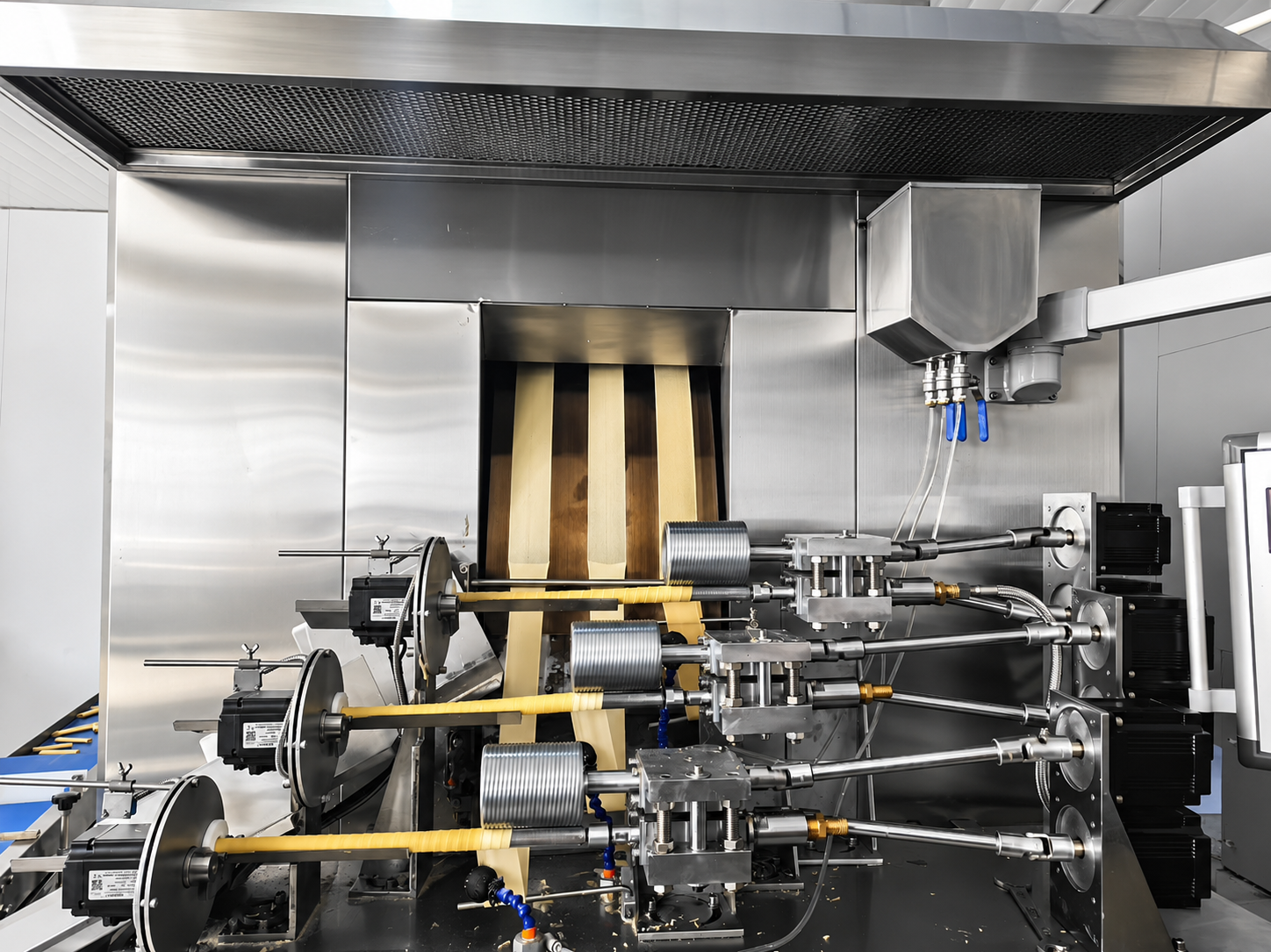
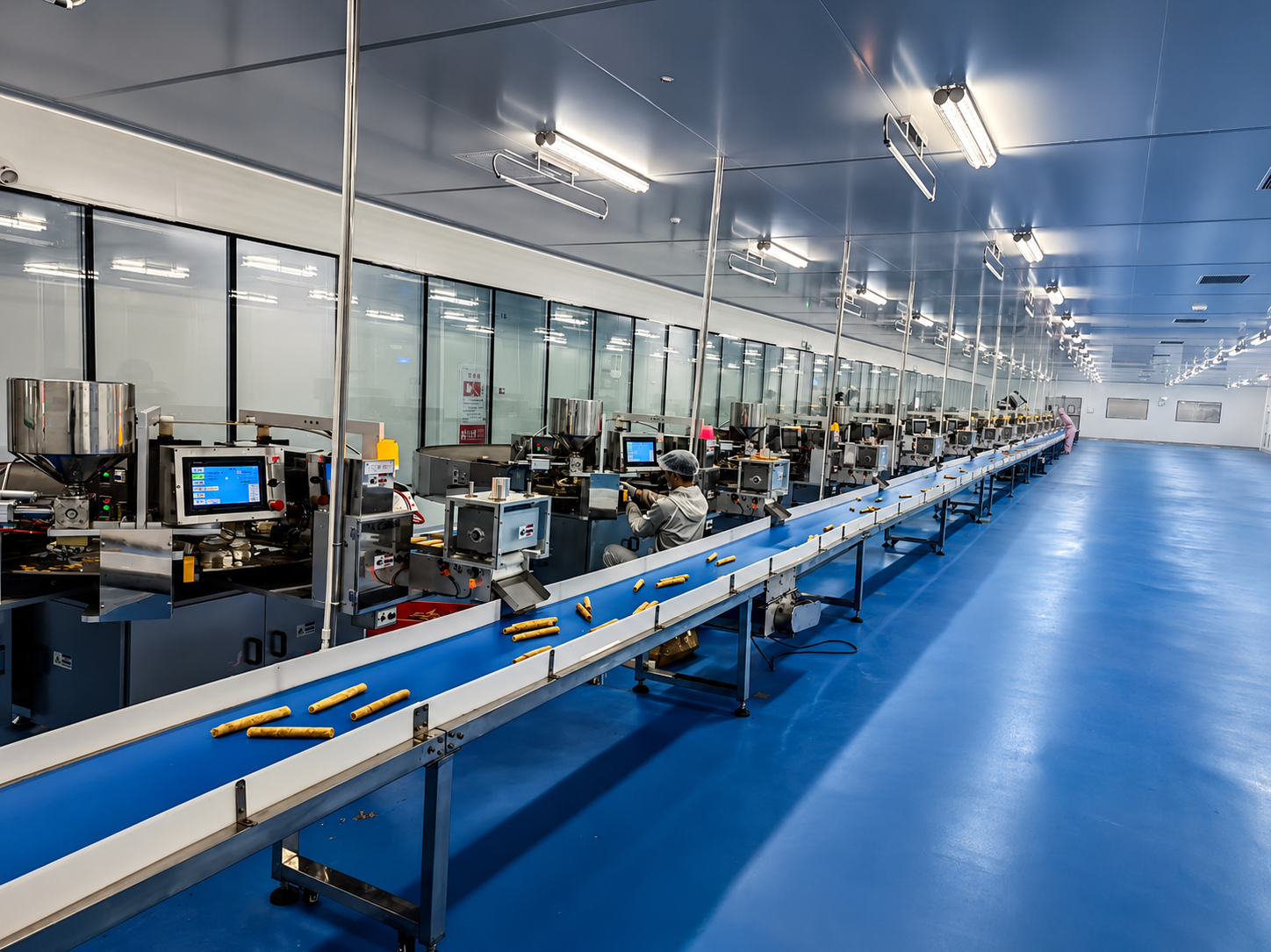
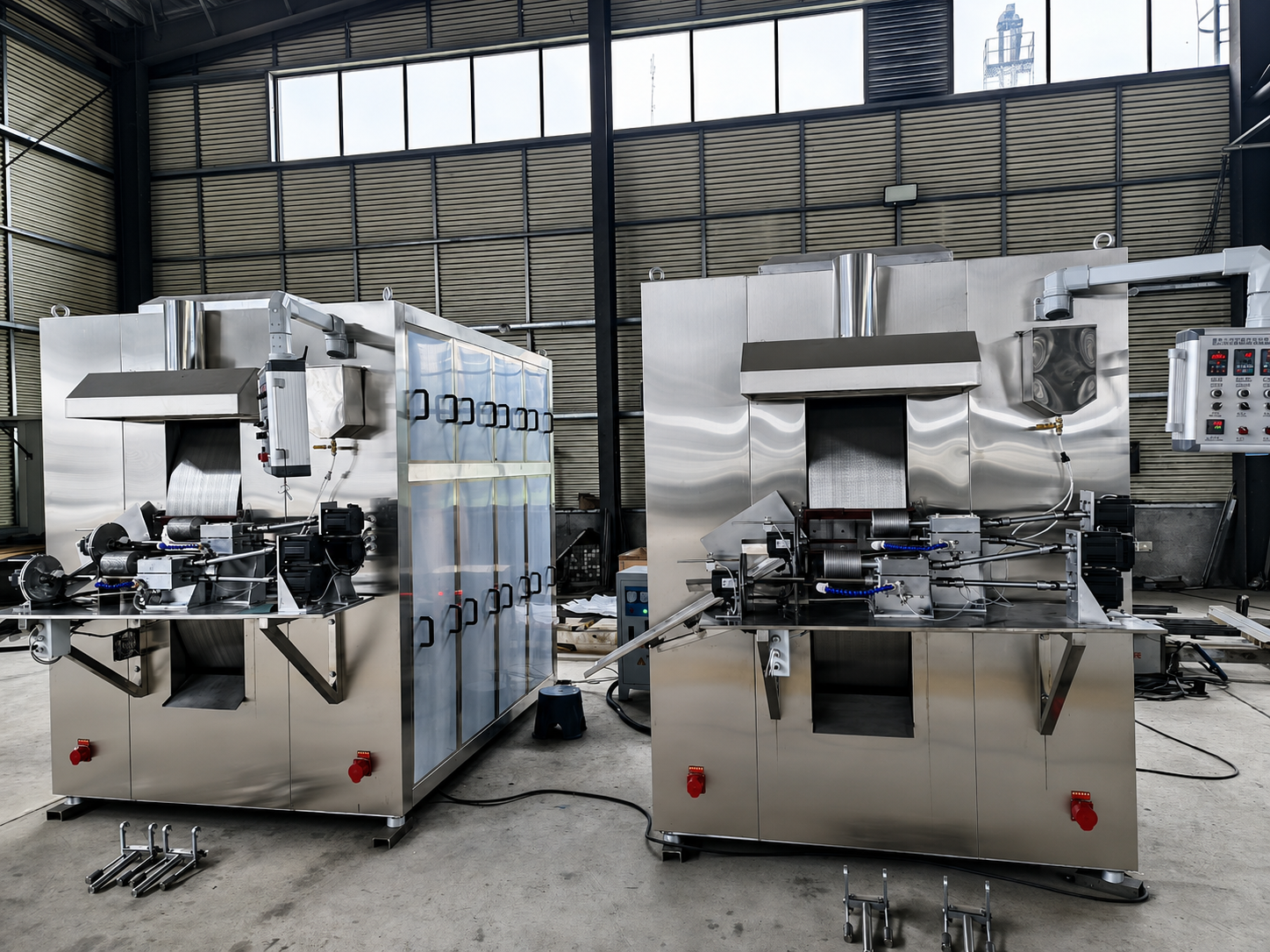
Food Processing Machinery Manufacturer for Snack and Bakery Production Lines
UDTECH is a food processing machinery manufacturer whose wafer and egg roll machines, waffle and pancake lines, sachima lines and mini bun lines are built in Xinyu, Jiangxi. Every line is configured around one thing: the product you already sell, its finished dimensions and the output you need per hour. The thirteen models below are published with their real dimensions, power draw and heat source, so you can rule most of them out before you speak to anyone.
| Four product families, 13 machine models |
| Output from 18 kg/h to 1,000 kg/h |
| Electric or gas-fired heating, stated per model |
| Your own product run on the line before it ships |
Process
We work from a photograph, the finished dimensions and piece weight of your product, your target output, and your floor space and utility supply.
UDTECH – Industrial Production Lines
UDTECH Food Processing Machinery at a Glance
Thirteen models are published here with their complete verified specifications, so a shortlist can be built before anyone is contacted. This is not the whole catalogue: where a model’s published figures could not be reconciled against the manufacturer’s own parameter sheet, it is left off this page rather than listed with gaps, so ask for anything you have seen elsewhere and do not find here. The commonest mistake in this category is comparing two quotations because the output figures look similar, when the gap between them is the measurement basis: a line rated 5,000 kg/24 h and a line rated 1,000 kg/h differ by roughly a factor of five, and only one of the two numbers says so.
Product families
Wafer and egg roll, waffle and pancake, sachima, biscuit and mini bunOutput range
18 kg/h on the nine-mould YT-02DJ to 1,000 kg/h on the sachima lineHeat source
Electric on eight models, natural gas or LPG on fiveMinimum order
One machine is a complete orderMachine models
13 published here with complete verified specifications, each with dimensions, power draw and outputElectrical load
3.0 kW on the gas-fired 32-mould waffle line to 418 kW on the all-electric mini bun lineWhere they are built
Xinyu, Jiangxi; ask for the module-by-module split between in-house build and partner supplyAcceptance
Your own recipe and finished dimensions are run on the line at the factory before shipment
Snack and Bakery Production Line Families
Four families cover everything UDTECH builds, and all four make baked or moulded food products from a batter, a dough or a syrup. Two of them are rotary machines that sit in a single bay; two are continuous lines that need tens of metres of straight floor. The choice between a single industrial food processing machine and a large-scale continuous line is settled by your building before it is settled by your budget.
SYS.01
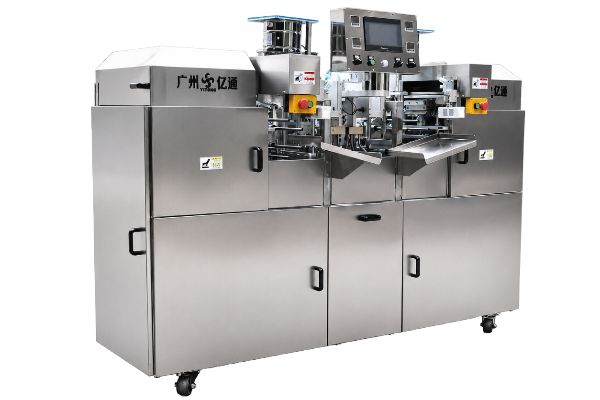
Wafer and Egg Roll Machines
YT-12 wafer and egg roll machine, 2,020 mm long, 11.1 kW electric.
Six models bake a thin wafer sheet and roll it into a hollow or filled stick. Output runs from 125 kg per day on the YT-06 up to 780 pieces per hour on the YT-02 rotary machine, with seaweed placing, sesame feeding and cutting available as built-in stations.
See all six wafer and egg roll modelsSYS.02
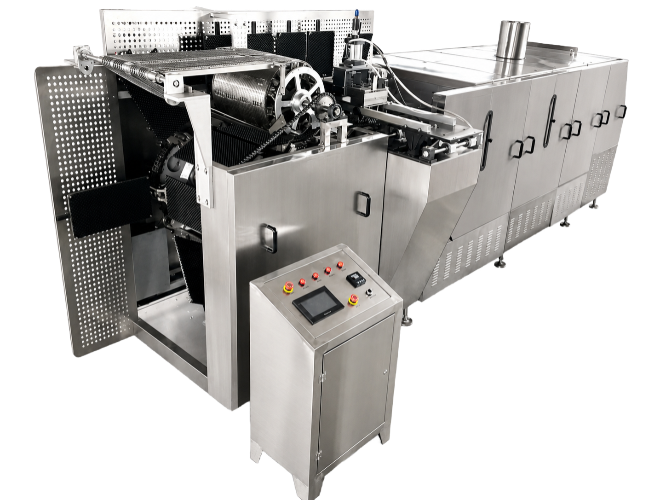
Waffle and Pancake Production Lines
YT-10-32M soft waffle line, 32 moulds, 6 m of floor length.
One pancake line, three soft waffle line sizes and one eight-mould rotary waffle machine. The 32-, 60- and 80-mould lines run 1,800, 3,500 and 5,000 kg/24 h respectively, on natural gas or LPG rather than on your electrical service.
Compare all five waffle and pancake modelsSYS.03
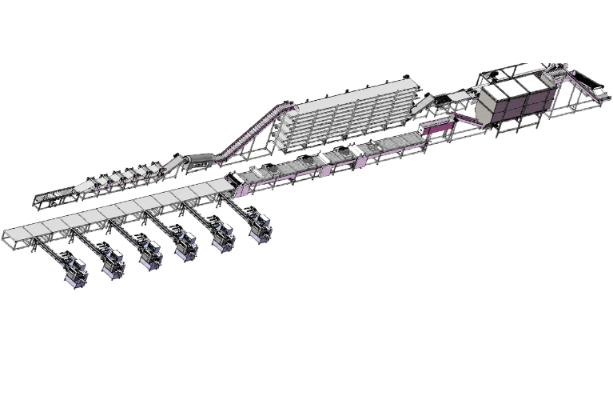
Sachima and Specialty Snack Lines
YT-30 sachima line, layout drawing. 70 m of straight run, 1,000 kg/h.
One continuous line, 70 m long, rated at 1,000 kg/h. Mixing, sheeting, cutting, frying, syrup coating, forming, cutting and packing run in sequence, gas-fired at 30 m³/h and 4 kPa.
See the sachima line and its module listSYS.04
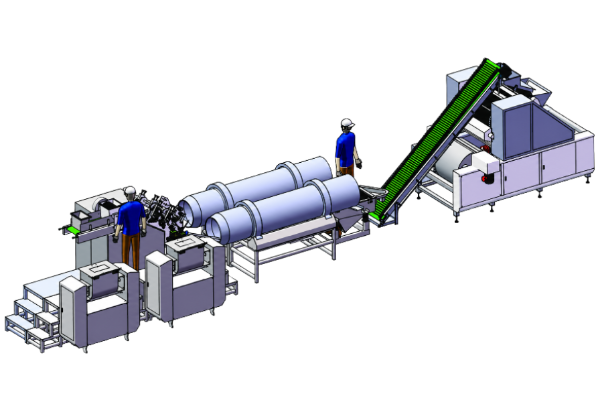
Biscuit and Mini Bun Lines
YT-XMT800 mini bun line, layout drawing. 55 m long, 418 kW electric.
One 55 m electric line rated at 4,000 kg/24 h. It carries a mixer, a sheeting and cutting station, a rounding unit, a lifting conveyor, a high-speed arraying head, a vibration sorter, the tunnel oven and the cooling section, with the control panels and working platforms that go with them.
See the mini bun and biscuit lineSYS.MODULES
Process Modules Built Into These Lines
- Batter and dough mixing with recipe-controlled dosing of flour, oil, sugar and liquids
- Batter depositing, dough sheeting and slicing to a set thickness
- Rotary mould baking and tunnel oven baking with zone temperature control
- Rolling, folding and forming stations with multi-axis servo motion control.
- Cutting blades, sesame feeding, frying and syrup coating
- Cooling conveyors, vibration sorting and high-speed arraying
- Discharge conveyors presenting product to your packaging machine
Food Processing Machines by Finished-Product Format
Machine selection starts from the product, not from the machine. Find the finished format you sell, then read the models against it.
Hollow baked wafer sticks with sesame, made on the wafer and egg roll machines.
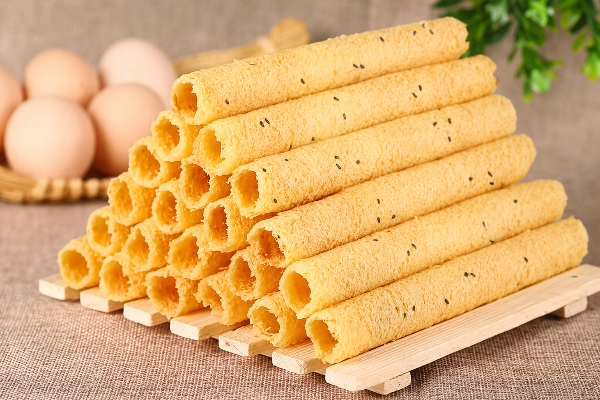
Models
YT-06, YT-12, YT-12HT, YT-02, YT-02D, YT-02DJ
What the line produces
Hollow or filled baked wafer sticks, seaweed-wrapped rolls and phoenix rolls
Output
125–350 kg per day on the manual-feed machines; 500–780 pieces per hour on the rotary machines
Heat source
Electric, 5.8–24 kW
Floor length
1.4 m to 2.7 m (4 ft 7 in to 8 ft 10 in)
Automation is the second axis in this family, and it shows in how output is quoted: the two manual-feed machines are published in kilograms per day, the other four in pieces per hour. Compare them only after converting both onto your own shift pattern.
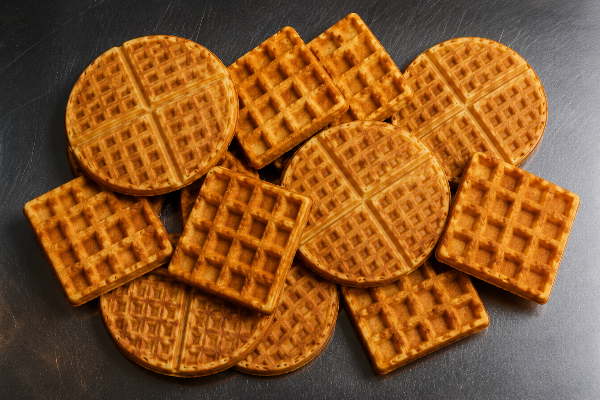
Models
YT-02H, YT-10, YT-10-32M, YT-10-60M, YT-10-80M
What the line produces
Soft waffles from an eight-mould rotary machine; thin pancakes and soft waffles from 32-, 60- and 80-mould tunnel lines
Output
1,100 pieces per hour on the YT-02H; 1,800, 3,500 and 5,000 kg/24 h on the three line sizes
Heat source
Electric 17.5 kW on the rotary machine; natural gas 8–19 m³/h or LPG 4–14 kg/h on the lines
Floor length
2.1 m to 12 m (6 ft 11 in to 39 ft 4 in)
The three tunnel sizes share one architecture, so the choice between them is a floor-space and output decision rather than a process decision. Our waffle and pancake line process guide walks through that comparison in detail.
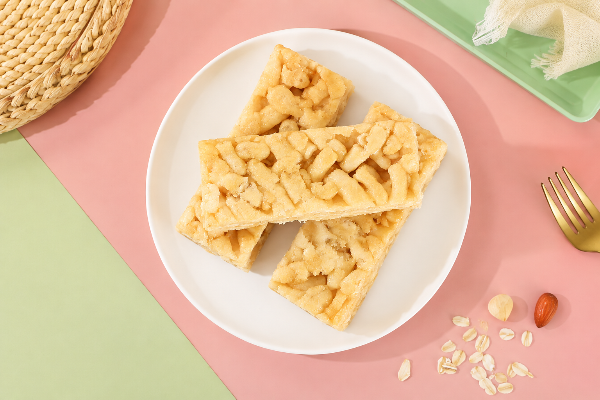
Models
YT-30
What the line produces
Fried noodle-dough bars bound with syrup, formed and cut to a set size
Output
1,000 kg/h
Heat source
Natural gas, 30 m³/h at 4 kPa, with an 88 kW electrical load
Floor length
70 m (229 ft 8 in)
This is the one continuous, fully integrated sachima production line in the range, and the only model that carries frying and syrup coating.
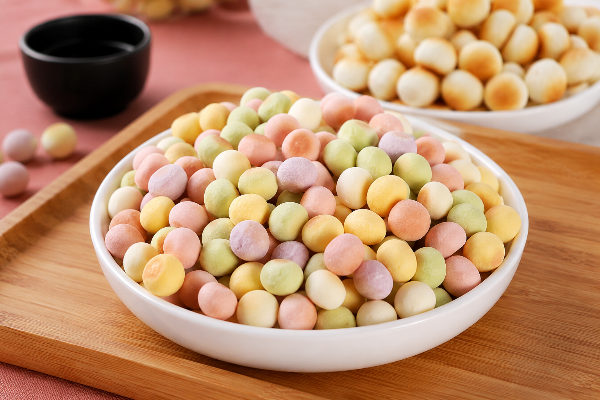
Models
YT-XMT800
What the line produces
Small round baked buns and baby biscuits, formed, sorted, baked and cooled in one pass
Output
4,000 kg/24 h
Heat source
Electric, 418 kW
Floor length
55 m (180 ft 5 in)
A Product Not Listed Here
Send a photograph and the finished dimensions and we will name the model that makes it, or tell you plainly that none of these thirteen does. A line built around the wrong forming geometry does not become right by adding modules to it.
Food Processing Equipment Modules And Scope Boundaries
A quotation for industrial food processing equipment is only as clear as the module list attached to it. Line engineers put the same point more bluntly: the quality of the finished product is set by the weakest piece of equipment on the line, so a strong oven behind a poor depositor buys you nothing. The table below sets out the eleven modules a UDTECH line can carry and where the boundary of a quoted line sits.
A line is quoted as the modules listed in its configuration. Anything not on that list is either named in the quotation or it is not in scope, and we would rather write the boundary down than let you assume it. These lines are modular at the configuration stage rather than after commissioning: the module list is settled before steel is cut, and a section added afterwards is a rebuild rather than a bolt-on.
The full model-by-model breakdown sits on the four family pages, including the waffle and pancake production lines.
Verified Machine Specifications
This is the food processing machinery UDTECH publishes here, thirteen models with complete verified specifications, and every figure in it comes from the parameter sheet for that model. Read it with one warning in mind: four different measurement bases sit in the output column, and only seven of the thirteen models can be compared on kilograms per hour without an assumption.
| Model | Family | Output | Electrical load | Heat source | Footprint L × W × H |
|---|---|---|---|---|---|
| YT-06 | Wafer and egg roll | 125–175 kg per day | 5.8 kW | Electric | 1,400 × 900 × 1,480 mm (4 ft 7 in × 2 ft 11 in × 4 ft 10 in) |
| YT-12 | Wafer and egg roll | 250–350 kg per day | 11.1 kW | Electric | 2,020 × 900 × 1,480 mm (6 ft 8 in × 2 ft 11 in × 4 ft 10 in) |
| YT-12HT | Wafer and egg roll | About 500 pieces per hour | 11.1 kW | Electric | 2,120 × 1,450 × 1,560 mm (6 ft 11 in × 4 ft 9 in × 5 ft 1 in) |
| YT-02 | Wafer and egg roll | 780 pieces per hour | 12.0 kW | Electric | 2,050 × 1,950 × 1,400 mm (6 ft 9 in × 6 ft 5 in × 4 ft 7 in) |
| YT-02D | Wafer and egg roll | 720 pieces per hour, 8 moulds | 12.0 kW | Electric | 2,050 × 1,950 × 1,400 mm (6 ft 9 in × 6 ft 5 in × 4 ft 7 in) |
| YT-02DJ | Wafer and egg roll | 500–600 pieces per hour, or 18 kg/h, 9 moulds | 24.0 kW | Electric | 2,700 × 2,100 × 1,500 mm (8 ft 10 in × 6 ft 11 in × 4 ft 11 in) |
| YT-02H | Waffle | 1,100 pieces per hour, 8 moulds | 17.5 kW | Electric | 2,100 × 2,300 × 1,400 mm (6 ft 11 in × 7 ft 7 in × 4 ft 7 in) |
| YT-10 | Pancake line | 3,500 kg/24 h, 60 moulds | 3.0 kW | Natural gas 14.5 m³/h or LPG 8 kg/h | 9,800 × 1,600 × 1,900 mm (32 ft 2 in × 5 ft 3 in × 6 ft 3 in) |
| YT-10-32M | Soft waffle line | About 1,800 kg/24 h, 32 moulds | 3.0 kW | Natural gas 8 m³/h or LPG 4 kg/h | 6,000 × 1,600 × 1,900 mm (19 ft 8 in × 5 ft 3 in × 6 ft 3 in) |
| YT-10-60M | Soft waffle line | About 3,500 kg/24 h, 60 moulds | 3.0 kW | Natural gas 14.5 m³/h or LPG 8 kg/h | 9,800 × 1,600 × 1,900 mm (32 ft 2 in × 5 ft 3 in × 6 ft 3 in) |
| YT-10-80M | Soft waffle line | About 5,000 kg/24 h, 80 moulds | 5.0 kW | Natural gas 19 m³/h or LPG 14 kg/h | 12,000 × 1,600 × 1,900 mm (39 ft 4 in × 5 ft 3 in × 6 ft 3 in) |
| YT-30 | Sachima line | 1,000 kg/h | 88.0 kW | Natural gas 30 m³/h at 4 kPa | 70,000 × 1,300 × 3,500 mm (229 ft 8 in × 4 ft 3 in × 11 ft 6 in) |
| YT-XMT800 | Mini bun and biscuit line | 4,000 kg/24 h | 418.0 kW | Electric | 55,000 × 1,900 × 3,000 mm (180 ft 5 in × 6 ft 3 in × 9 ft 10 in) |
Seven of these machines need compressed air at 0.2 m³/min above 0.6 MPa — the YT-02, YT-02D, YT-02H, YT-06, YT-12, YT-12HT and the YT-30 sachima line — while the three soft waffle lines are quoted at 0.6 m³/min, three times that flow, and the YT-02DJ is quoted differently again, at 0.4–0.7 MPa with no flow rate on its sheet. Size the compressor on the waffle lines if you are running a mixed floor, and ask for the YT-02DJ flow figure before you commit to it. Net machine weights are 900 kg on the YT-02DJ, 960 kg on the YT-02 and YT-02D and 1,000 kg on the YT-02H, which is what your rigger will ask for first.
The electrical figure and the heat figure are not interchangeable. A gas-fired waffle line draws 3 kW because its heat comes from the burner; an electric line of comparable output draws hundreds of kilowatts because the heat is inside that same number. Work out kWh per kilogram on both columns, or you will end up comparing a burner against an oven and calling one of them efficient.
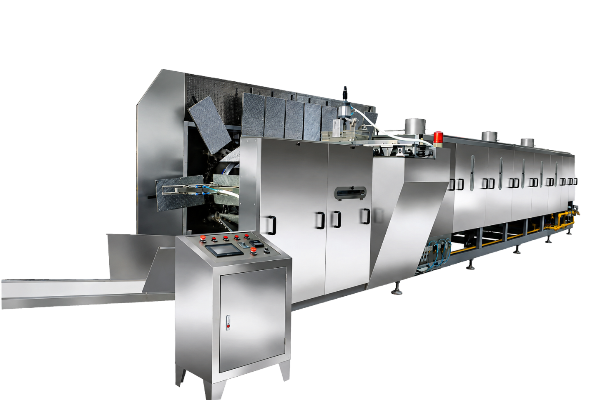
SYS_OVERVIEW // V.10
ACTIVE_MODULE // T-800
UDTECH ENGINEERING TEAM
Worked on the figures above at rated load — nameplate arithmetic, not metered consumption — the YT-10-80M works out at 0.024 kWh and 0.091 m³ of gas per kilogram of product; the YT-XMT800 works out at 2.508 kWh per kilogram and no gas at all. That hundredfold gap is in the electrical column alone, and it is not an efficiency comparison: the gas figure stays in cubic metres exactly as the parameter sheet gives it, rather than being converted on a calorific assumption nobody has published for your gas supply.
Quotation Mechanism, Lead Time and What Drives Line Cost
There is no price list for a production line. Your figure follows the model you select, the mould or lane count, the heat source your plant can supply, the modules you keep in scope and the trade term you buy on. Two plants moving into food production at the same volume can be quoted very differently on those five variables alone, which is why a number quoted before they are settled is a number that will change.
What Moves Your Line Cost
| Driver | Effect on cost | How to reduce it |
|---|---|---|
| Mould or lane count | Sets throughput and most of the mechanical content at once. The 80-mould waffle line is twice the length of the 32-mould line and carries about 2.8 times its output. | Size the line on the output you will sell in year one, not on peak ambition. |
| Heat source | A gas-fired line moves the energy load off your electrical service; an electric line needs that service to already be there. | Confirm gas pressure and flow, or spare electrical capacity, at the installation point before the line is specified. |
| Modules in scope | Cutting, sesame feeding, frying, syrup coating, sorting and arraying are separately engineered sections, not switches. | Name the modules you already own so they are not quoted into the line twice. |
| Product format range | A line built for one finished dimension is simpler than one that has to swap moulds between formats. | List every product size you intend to run before mould drawings are released. |
How Your Quotation Is Produced
An engineer reviews every quotation before it is sent, and the turnaround for your line is stated on that line's page. Each of the four family pages publishes its own commercial terms, because a rotary machine and a 70 m fried-product line are not sold on the same clock.
What Sets the Clock at Each Stage
| Order stage | What sets its clock | What it covers |
|---|---|---|
| Configuration | Closes when the machine configuration is signed | Product sample review, mould drawings, module list and utility requirements |
| Production | Runs against the signed configuration | Fabrication, assembly and dry running of the line at the plant |
| Acceptance | Starts when your product is run on the line | Test run against the recorded criteria, filmed or attended |
| Shipment | Follows the trade term written into your contract | Packing, documents and hand-over to the carrier |
Production lead time is quoted against the signed machine configuration for your line, with ocean transit quoted separately. Changing the mould drawing after that signature restarts the clock, which is why the configuration stage is worth the attention it takes.
Payment, Trade Terms and Order Size
Payment is a deposit on order confirmation with the balance settled on the shipping milestone written into your contract; a letter of credit at sight is accepted. We quote EXW, FOB, CFR or CIF, set with the quotation for your line. One machine is a complete order, so there is no batch minimum to clear before you can buy a single machine.
Before You Enquire
If you want to arrive at the enquiry with everything an engineer needs, work through our quotation readiness checklist first. It was written for the sachima line but the fields it asks for are the same across all four families, including the biscuit and mini bun lines.
Send Your Product Photo for a Quotation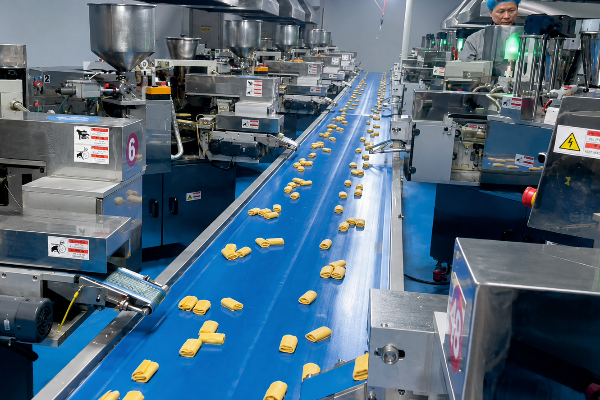
Pre-Shipment Testing and Machine Construction
A machine that has never made your product is an unproven machine, whatever its parameter sheet says. Before a line leaves the plant, your own recipe and your own finished dimensions are run on it and recorded.
How a Line Is Checked Before It Ships
- Your product sample, its finished dimensions and its piece weight are recorded as the acceptance criteria, before any steel is cut.
- The line is assembled and dry-run at the plant against those criteria, module by module.
- We run your own product on the line before shipment; attend the acceptance test in person, appoint a third-party inspector, or take the run as a filmed record.
- The test run record is packed with the machine, so the standard the line was accepted against travels with it.
The point of that sequence is that acceptance is decided against a written criterion agreed in advance, not against an opinion formed after delivery.
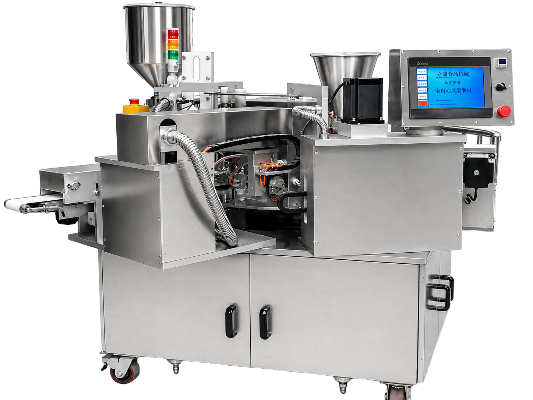
What to Verify on Any Food Machine
| Inspection dimension | Where the requirement is written | What to ask any supplier to show you |
|---|---|---|
| Food-contact surfaces and materials | 21 CFR 117.40 equipment and utensils of adequate design, material and workmanship to be adequately cleanable, with corrosion-resistant food-contact surfaces |
Material certificates covering every surface the product touches |
| Seams, crevices and drainability | EN 1672-2:2020 hygiene and cleanability requirements for food processing machinery |
Product-zone drawings showing weld finish and drainage paths |
| Disassembly and cleaning access | EN 1672-2:2020 |
A cleaning procedure naming which parts come off without tools |
| Machine guarding and point of operation | 29 CFR 1910.212 general requirements for all machines |
Guard drawings and the interlock list |
| Machinery conformity for the destination market | Directive 2006/42/EC for a line placed on the European Union market or put into service there before 20 January 2027; Regulation (EU) 2023/1230 on machinery from that date |
A written statement of which market's conformity documentation is inside the quotation |
| Fabrication depth | Third-party fabrication audit criteria: quality programme, material certifications, weld quality, surface finish, cleanability, drainability and inspection access | The engineering design and construction file for your machine, and how long it is retained after shipment |
Run that table against us and against every competing quotation you hold. A supplier who cannot produce the drawing, the certificate or the guard list for a machine they are asking you to buy is telling you something useful. None of it is an industry courtesy: the middle column names where each requirement is written down.
DOC-01
Documents, Warranty and After-Sales Scope
Every order ships with the full commercial and customs document set, the operation and maintenance manual and the pre-shipment test run record.
Machines carry a warranty of 12 months from commissioning, excluding consumable and wear parts. Installation, commissioning and operator training happen at your factory on your own line, with travel, visa and accommodation to the buyer's account.
QA-02
If the Line Does Not Meet the Acceptance Criteria
If the line does not make your product to the criteria recorded at the start, it does not ship until it does. The criteria are the ones written down before the build, not renegotiated at the point of failure.
INIT-03
Project Initiation
Establish exact technical parameters and contractual acceptance standards prior to engineering design.
Tailored Line Engineering: From Product Sample to Commissioned Line
-
Send your product
A photograph, the finished dimensions, the piece weight and your target output. A physical sample if you have one to spare.
-
Line selection
We name which of the thirteen models can make it, and which cannot. If the answer is none of them, you hear that in the first reply.
-
Configuration and quotation
Mould drawings, module list, utility requirements and the trade term, priced as one configuration rather than as a catalogue line.
-
Build and assembly
The line is fabricated, assembled and dry-run at the plant in Xinyu, Jiangxi.
-
Acceptance run
Your product runs on the line here. If it does not meet the recorded criteria, that is our problem to solve before shipment, not yours to discover after it.
-
Installation, commissioning and training
Our engineers install and commission the line at your factory and train your operators on the machine they will actually run.
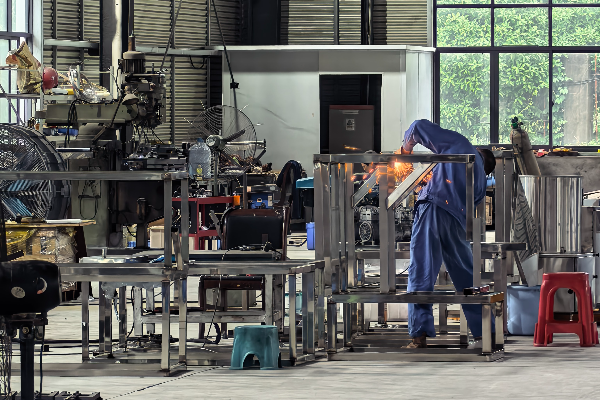
Specification Notes That Lower Your Line Cost
| Decision | What to specify | Why it saves money |
|---|---|---|
| Output basis | Kilograms per hour, or pieces per hour together with the piece weight in grams | Four measurement bases are in use across these lines. Quoting against the wrong one buys the wrong size of line. |
| Finished dimensions | Length, width and thickness of the finished piece, before mould drawings are released | Moulds are the long-lead item. A dimension change after cutting is a new mould set, not an adjustment. |
| Heat source and utilities | Natural gas pressure and flow, or spare electrical capacity, measured at the installation point | A 418 kW electric line and a 30 m³/h gas line make very different demands on the same building. |
| Floor space | The clear straight run available, not the room area | The sachima line needs 70 m of straight run. A 70 m² room will not take it, however the area is arranged. |
| Format range | Every product size you intend to run on the line | Mould changeover designed in at the start costs less than a retrofit after commissioning. |
Engineering Origin and Product Development Record
These lines are built in Xinyu, Jiangxi. The development record worth showing is in the machines themselves rather than in a corporate timeline, so what follows is the equipment: what each machine does, what it draws, and what it leaves for you to verify.
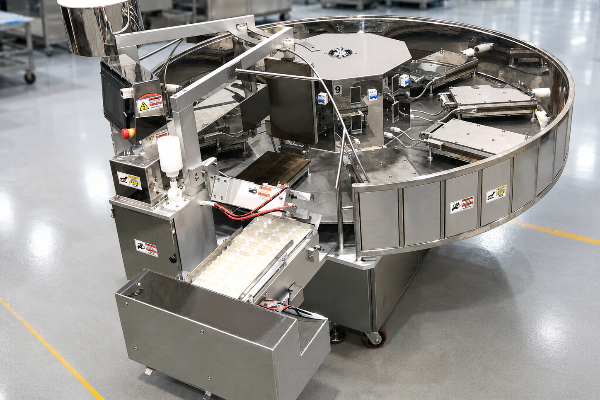
YT-02DJ, nine hinged mould plates on one carousel, 24 kW, 2,700 mm across.
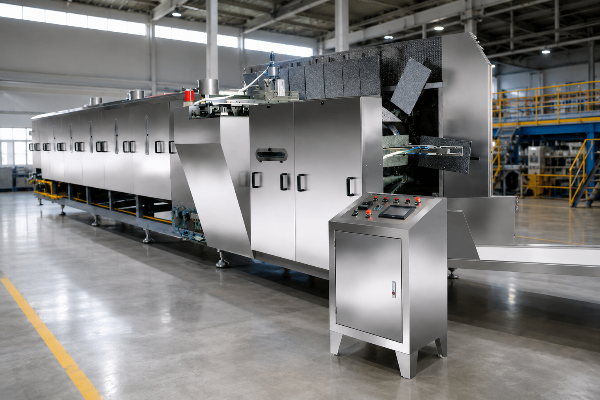
YT-10 pancake line, 60 moulds over 9.8 m, gas-fired at 14.5 m³/h.
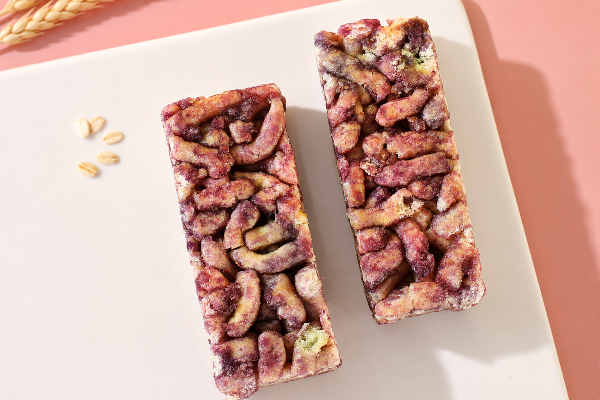
Sachima bars, the finished format the YT-30 line is built around.
How the Rotary Machines Developed
The YT-02 is the base configuration in this range: a rotating carousel where seaweed placing, batter depositing, heating, folding, rolling and demoulding each happen at a fixed station, under PLC control with multi-axis servo motion and fibre-optic photoelectric sensing.
The YT-02D took the same 2,050 × 1,950 mm footprint to eight moulds. The YT-02DJ widened it to 2,700 mm for nine moulds and split into three configurations: standard, with cutting, and with cutting and sesame feeding.
Mould Count Against Piece Weight
The reason that progression matters to a buyer is arithmetic. Nine moulds on the YT-02DJ produce 500–600 pieces per hour against 720 on the eight-mould YT-02D, because the nine-mould machine is baking a different product, quoted at 18 kg/h — which works out at 30 to 36 g a piece, where the eight-mould machine publishes no piece weight at all.
Mould count on its own tells you nothing until the piece weight is on the table beside it.
What to Verify Before You Buy Any Line
Identity claims are cheap to make and hard to check. These are the things a buyer can actually verify, and they work as well against us as against anyone else quoting you.
| What to verify | What to ask for |
|---|---|
| Production equipment and facilities | Photographs or a video walk-through of your line being assembled, not a catalogue render |
| Technical skill | The mould drawing for your product dimension, produced before you pay a deposit |
| Quality assurance | The written acceptance criteria for your machine, and the name of whoever signs them off |
| Operational control | Which modules are built in-house and which come from a partner, module by module |
| Delivery capability | A test run of your own product, filmed or attended in person |
| Financial and accounting capability | Payment milestones tied to physical events you can verify, not to calendar dates |
Who These Lines Are Built For
Tailored engineering designed specifically to transition manual or semi-automatic output onto continuous processing.
Snack food manufacturers
Producers moving a proven wafer, waffle or fried bar product from manual or semi-automatic output onto a continuous line.
Industrial bakery equipment buyers
Bakery and pastry operations adding a formed-and-baked product family alongside existing bread or biscuit capacity.
Contract manufacturers
Co-packers who need a line specified against a client's finished dimensions and piece weight rather than against a catalogue.
Food and beverage brands
Brand owners taking production in-house and buying commercial food processing equipment for the first time, who need the scope boundary written down.
Ask for a Floor-Space Layout Sketch
Send your building dimensions and we will draw the line into them. The machine dimensions in the specification table are enough to produce that sketch, so it needs nothing from you but the room.
Where These Lines Are Not The Right Fit
Four situations where buying one of these lines is the wrong answer, each with what to do instead. A bigger line buys you throughput and costs you floor length, utility supply and capital parked in a machine that stands idle, and that trade-off is the whole of this section.
Why it works against you
A rotary or tunnel line is priced on continuous output. At that volume most of the machine stands idle and the capital sits with it.
What to do instead
Start with a single manual-feed machine such as the YT-06 at 125–175 kg per day and add capacity once the volume is real.
Why it works against you
These are batter, dough and syrup lines. The forming and baking geometry is built for one class of product and does not generalise.
What to do instead
Specify against a supplier whose processing solutions are built for that raw material, and send us the product photograph anyway so you get a straight answer rather than a guess.
Why it works against you
The two largest lines are constrained by the building long before they are constrained by the budget.
What to do instead
Specify against the smaller models, or plan the building first and the line second. The footprint planner above gives you the numbers to argue with.
Why it works against you
Moulds are cut for a finished dimension. Frequent format changes mean either more mould sets or a line running below its rated output.
What to do instead
List every format at the configuration stage so mould changeover is engineered in rather than retrofitted later.
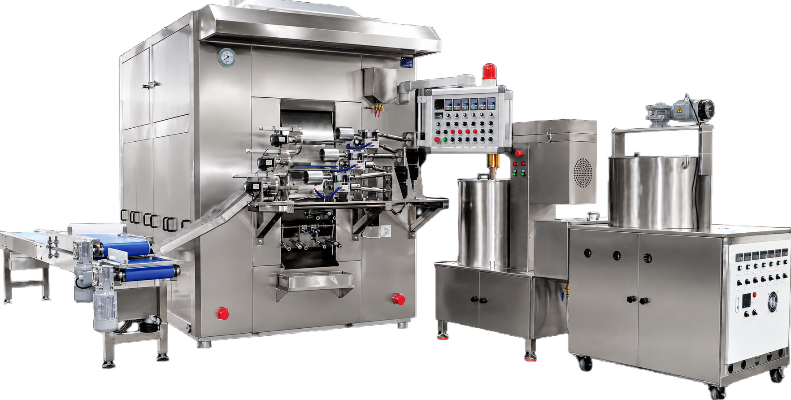
UDTECH Production Planning Tools
-
Accurately forecast your production throughput based on equipment specifications and operational variables.
-
Optimize your factory floor layout by calculating the spatial requirements for your new food processing lines.
-
Estimate power and utility consumption to project operational expenses and ROI for your automation upgrade.
01
What is the difference between an egg roll machine and a wafer roll machine?
In United States usage, an egg roll is a filled and wrapped savoury appetiser. The machines on this page bake a thin wafer sheet and roll it into a hollow or filled stick — the crisp product sold as an egg roll biscuit across Asia and as a wafer roll elsewhere. If you are sourcing equipment for the filled appetiser, none of these thirteen models will make it, and the wafer and egg roll machines page shows the finished product so you can check before you enquire.
02
How do I compare capacity when suppliers quote in different units?
Four bases appear in this range alone: kilograms per hour, kilograms per 24 h, kilograms per day with the length of the day undefined, and pieces per hour with no piece mass given. Only seven of the thirteen models can be placed on a kilograms-per-hour basis without an assumption.
- Ask for the piece mass in grams.
- Ask how many running hours sit behind the word "day".
One thing holds whoever the supplier is: the capacity figure in a machinery quotation is a running rate, taken with the machine on one product at one piece weight and nothing interrupting it. Ask which of changeover, cleaning, start-up scrap and short stops it already accounts for; on most quotations the answer is none of them. Plan on that figure and you plan on one nobody intended you to hit.
03
Why does a gas-fired line show a much lower electrical rating than an electric one?
Because the heat is being counted in a different column. The YT-10-80M draws 5 kW and burns 19 m³/h of natural gas; the YT-XMT800 draws 418 kW and burns nothing at all. Per kilogram of product that is 0.024 kWh against 2.508 kWh, and the gap is an accounting boundary rather than an efficiency difference.
04
What does mould count tell me about a line?
It sets throughput and floor length together, but not in proportion. The 32-, 60- and 80-mould waffle lines run 1,800, 3,500 and 5,000 kg/24 h at 6 m, 9.8 m and 12 m of length, so output roughly triples while length only doubles. Mould count says nothing about output on list own until the finished piece weight is fixed.
05
Do these machines meet United States food safety requirements?
Food safety compliance is established in your plant, not on a supplier's web page. 21 CFR 117.40 places the requirement on equipment being of adequate design, material and workmanship to be adequately cleanable, with corrosion-resistant food-contact surfaces; destination-market conformity documentation is a project-specific item either named in the quotation or outside its scope. Ask any supplier for material certificates covering every product-contact surface and for the product-zone drawings, and judge the answer rather than the claim.
06
How do I know the machine will actually make my product?
We run your own product on the line before shipment, and you are welcome to attend the acceptance test in person, appoint a third-party inspector, or take the run as a filmed record. The criteria for that run are your finished dimensions and piece weight, recorded before the build starts rather than agreed afterwards.
07
What is the warranty and what does it exclude?
Machines carry a warranty of 12 months from commissioning, excluding consumable and wear parts, which are quoted as spares. Counting from commissioning rather than from shipment matters when a line spends weeks at sea and more weeks in your building before it is switched on.
08
Who installs the line and who pays for it?
We provide installation and commissioning at your factory and operator training on your own line, with travel, visa and accommodation to the buyer's account, followed by spare-parts supply and remote technical support. Training is delivered on your machine rather than on a demonstration unit.
09
What payment and trade terms do you work on?
A deposit on order confirmation, the balance on the shipping milestone written into your contract, or a letter of credit at sight. The trade term — EXW, FOB, CFR or CIF — is set with the quotation, so the point at which risk and cost transfer to you is written down before you order.
10
What documents ship with the machine?
Every order ships with commercial invoice, packing list, bill of lading, certificate of origin and the operation and maintenance manual, together with the pre-shipment test run record. That last document is the one worth keeping: it is the standard your line was accepted against.
11
What do you need from me to quote?
We work from a photograph and the finished dimensions of your product, its piece weight, your target output per hour or per day, and the floor space and utility supply available at your site. Those five items are enough to name a model and rule the other twelve out. What we cannot quote against is an adjective: a specification that asks for a high-quality finish without naming the finished dimension, the piece weight and the tolerance you will accept has not said anything a mould can be cut to.
12
Is one machine enough to place an order?
One machine is a complete order. Lines are configured per order rather than built to stock, so there is no batch quantity to reach before a single machine can be bought.
13
How long does a line take to build?
No single figure covers thirteen models, so the turnaround for your line is published on its own family page rather than averaged into one number here. The clock starts at the signed machine configuration and runs separately from ocean transit; mould count, module list and heat source all change the build, which is why a figure quoted before the configuration is signed is a figure about nothing.
14
How do I check a supplier I cannot fly out to visit?
Run the verification table in the record section above against us and against every competing quotation you hold. Before a deposit is paid, ask for four things.
- The mould drawing for your own product dimension.
- The written acceptance criteria, with the name of whoever signs them off.
- A module-by-module answer on what is built in-house.
- The test run of your product, filmed or attended.
Tie the payment milestones to those physical events rather than to calendar dates. A supplier who will not produce those four has answered the question.
15
What happens when the line stops and I am on the other side of the world?
Remote technical support, worked through the operators we trained on your own line, with the test run record as the known-good standard a fault gets described against. Order the wear parts as spares with the machine: those are the ones that stop a line, and the ones you least want to be shipping across an ocean.